BY VK SHASHIKUMAR
The Jantar Mantar crackdown has given a new generation of mainland Indians its first direct experience of the Indian state’s impunity in using unaccountable brutal power against its citizens.
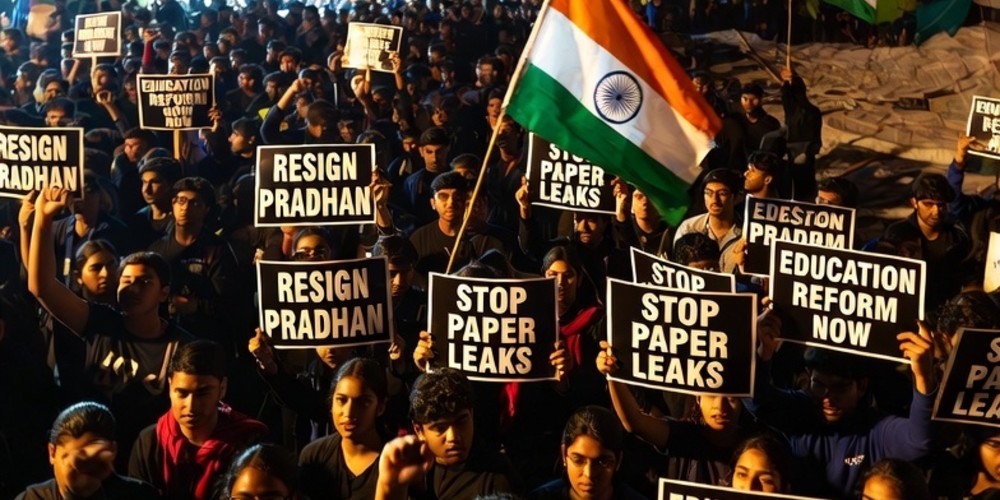
Media has reported that pellet guns were fired at student protesters on 20 July 2026 in Delhi, apparently for the first time in the capital city. What was tested on Kashmiri teenagers, far from the eyes of mainstream India, is now aimed at the children of Delhi’s middle class.
During the 2016 Kashmir unrest, “non-lethal” pellet-firing shotguns produced what locals called the year of mass blinding. At least 139 people, mostly youngsters, were blinded between July 2016 and February 2019. The pellet guns continue to be in use in the valley.
And now the weapon has travelled from Kashmir to the national capital.
For millions of Indians in Jammu & Kashmir, Manipur, across much of northeast India, Chhattisgarh and several other parts of India, the impunity of unaccountable violence perpetrated by police and security forces have never been an abstraction.
If Gen Z wants to understand what happened to it at Jantar Mantar, it should study the institutional roots of Indian state violence. This has been happening, for decades, but Indian citizens were conditioned to unsee it.
Let’s start with the law under which security forces in Nagaland, Manipur and Jammu & Kashmir have operated for generations. The Armed Forces (Special Powers) Act is not a product of independent India’s imagination. Its direct ancestor is the Armed Forces Special Powers Ordinance of 1942, promulgated by Viceroy Linlithgow on 15 August 1942 to crush the Quit India Movement, a measure that gave soldiers what critics then and since have called a “license to kill”.
In 1947, the new republic of India did not discard this law, instead it adapted it. Ordinances modelled on the 1942 law were issued in 1947 to manage Partition unrest and in 1958 Home Minister G.B. Pant piloted the Armed Forces (Assam and Manipur) Special Powers Act through Parliament to fight the Naga insurgency.
The Act allows even a non-commissioned officer to open fire on anyone who he thinks is contravening an order in a “disturbed area” and bars prosecution of security personnel without central government sanction, a sanction that has almost never been granted.
The same protection against prosecution runs through the police forces across the country. Most state police forces still trace their statutory protections to the Police Act of 1861, drafted after the 1857 rebellion to create a police force that answered to the executive, not the citizens.
Despite the Supreme Court’s directives on police reform in Prakash Singh v Union of India (2006), the constitutional mandate to make police forces genuinely citizen-centric remains largely unimplemented by states.
Therefore, when young India is demanding accountability, it should also understand why a grandfatherly government doesn’t want this generation to know more about people like human rights defender Jaswant Singh Khalra.
He used municipal cremation records between 1984 and 1995 to establish that security forces had abducted, killed and secretly cremated an estimated 6,017 people as “unidentified” bodies in Amritsar district alone, one of thirteen districts in Punjab. For this discovery, Khalra was himself abducted by police in September 1995 and never seen again.
The National Crime Records Data shows that not a single police official was convicted for a custodial death between 2018 and 2021, while rights groups have documented more than 11,000 custodial deaths (police and judicial) between 2016 and 2022, roughly five every day.
India signed the UN Convention Against Torture in 1997 and the Congress and BJP governments alike, never ratified it and has never enacted a standalone anti-torture law.
In Kashmir, where an armed terror movement erupted in 1989, the state’s response produced its own grim ledger: from the mass rape allegations of Kunan Poshpora in February 1991, where an FIR recorded 23 women’s complaints against an army unit to thousands of extra-judicial executions and enforced disappearances. None of these cases ever reached the trial stage.
In 2011, the state’s own Human Rights Commission confirmed 2,730 bodies in unmarked graves across north Kashmir, of which 574 were identified as local residents, not the “foreign militants” official accounts had claimed.
In Manipur, the record is condensed in two images: the bullet-riddled body of Thangjam Manorama, picked up by the Assam Rifles in July 2004 and found dead the next morning; and the naked protest of twelve Meitei mothers outside Kangla Fort under the banner “Indian Army Rape Us.”
In 2012, the Extrajudicial Execution Victim Families Association petitioned the Supreme Court alleging 1,528 fake encounters in Manipur between 1979 and 2012. In its landmark 2016 judgment, the Court held that every death caused by security forces must be investigated, whether the dead were insurgents or civilians, AFSPA or no AFSPA.
The government has since rolled back AFSPA “disturbed area” notifications in significant parts of the Northeast.
It must be said that the Indian state has faced real armed terrorist violence and significant threats to its national security and integrity. Terrorism in Punjab, Jammu & Kashmir and the Northeast and a Maoist insurgency in parts of India, all of which killed thousands of civilians and security personnel.
A review of state violence is not a denial of insurgent and terrorism violence. It is simply an insistence that a constitutional state be judged by constitutional standards.
The Unlawful Activities (Prevention) Act, enacted in 1967 and hardened by the Congress-led UPA in 2008 and by the BJP in 2019, has become the signature instrument of State impunity.
In the Delhi riots “conspiracy” case, student activists including Umar Khalid and Sharjeel Imam have now spent over five years in jail without their trial meaningfully beginning. The 7,000-page charge sheet stitches WhatsApp chats and protest speeches into a terror conspiracy.
The riots, in February 2020, killed 53 people, 36 of them Muslim, amid widely documented allegations of police inaction and partisanship. In May 2026, the Supreme Court itself flagged that UAPA conviction rates run between roughly 3% and 6% nationally and under 1% in J&K.
Several observers have noted that for the Indian State, allegedly, the unlawful process itself is a punishment. The years in jail are the punishment, and it appears as if it is not interested in convictions.
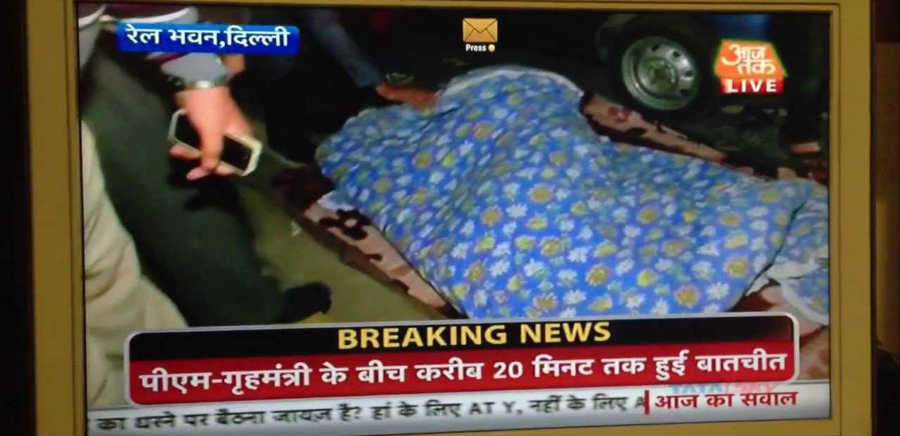
At Jantar Mantar on 20 July 2026, the Delhi police brutality perpetrated on young Indians has connected the Gen Z to the historical arc of violence stretching from Kunan Poshpora and nearly 40 years of violence in J&K to cremation grounds in Punjab during the days of terror unrest to the violence perpetrated on communities in Chhattisgarh and Manipur.
Nearly 800 million Indians are below the age of 35. Most of them have just watched, on their own phones, in their own feeds, what the state’s brutal and coercive machinery looks like when it turns on its own children. Many faced it upfront for the first time in their lives. That is a bitter education, but it is also an extraordinary source of power.
No government can indefinitely ignore a demographic of nearly 800 million Indians under the age of 35. The government may well remind itself that when Gen Z decides what it wants, they won’t be bullied into submission.
If this generation converts its anger into a sustained demand for reforms that serve citizens rather than rulers, it will make India a humane and better democracy.
(VK Shashikumar is a former roving foreign affairs correspondent who covered West Asia, and later set up the investigations team at CNN-IBN, now News18. He writes on geopolitics, conflict, and strategic affairs. The opinions expressed by the author and those providing comments are theirs alone, and do not reflect the opinions of Canary Trap or any employee thereof)